We are pleased to invite you to the upcoming meeting on behalf of the International Forum for Headache Nurses (IFHN). This event is aimed at IFHN members and headache nurses from around the world. The gathering offers a wonderful opportunity to meet, share experiences, enhance skills, and strengthen the role of nurses in headache care.
Location and dates: Oslo University Hospital, Rikshospitalet (Sognsvannsveien 20, 0372 Oslo), Thursday May 28 and Friday May 29 2026.
As is usual for local IFHN meetings, participation in the meeting is free of charge. Lunch and refreshments will be provided free of charge on both days.
On Thursday, May 28, we are planning a shared dinner in Oslo, likely with a short professional presentation. Further details regarding the location, cost, and registration for the dinner will be sent out later.
Travel and accommodation expenses are to be covered by the individual participant or their employer.
If you are a member of IFHN, you will receive an invitation with information on suggested accommodation and how to register for the meeting.
There are more nurses speaking in the programme. The preliminary programme is as follows:
Thursday 28 May 2026
10.30 – 11.00
Registration and coffee
11.00 – 11.05
Welcome
Jennifer Trouerbach, Anne Hege Aamodt and Kristine Jacobsen
11.05 –11.35
Treatment Options in Chronic Migraine – Evidence, Experience, and Emerging Therapies
Prof. Anne Hege Aamodt, neurologist; Dr. Burcu Bezgal and PhD student, neurologist, Oslo University Hospital
11.35-12.00
Medication-overuse Headache – When Treatment Becomes the Trigger
Dr. Maria Argren, PhD student and neurologist, Oslo University Hospital
12.00 – 12.20
Digital Home Follow-up (DHO) for Headache – New Perspectives in Patient Care
Dr. Bendik Windsvold, Neurologist, Ingrid Antoinette Ter Woerds Christensen, PhD Candidate in Nursing
13.30 – 14.10
Multidisciplinary Headache Treatment – Helping Patients Return to Work
Dr. Kjersti Vetvik, neurologist, Inger Louise Hole; psychologist, Akershus University Hospital
14.10-14.30
Women’s Health and Migraine – What Do Hormones Have to Do with It?
Dr. Kjersti Vetvik, Neurologist, Akershus University Hospital
14.30-15.00
Presentation of Headache Care in Different Countries
United Kingdom Netherlands Norway
15.25-15.45
IFHN – Updates, Collaboration and Next Steps
Jennifer Trouerbach, Headache Nurse and the president of the International Headache Forum
15.45 – 16.05
Cluster Headache and TACs – How to Differentiate Between Primary Headache Types?
Dr. Aud Nome Dueland, neurologist, User Organisation Headache Norway
16.05-16.50
Empowering Patients: Why Health Literacy Is Crucial to Managing Headache
Kristina Kuhlefelt, headache nurse, Hospital of Telemark; Dr. Tine Poole, Oslo Headache Centre; Secretary General Laila Mathisen, User Organisation Headache Norway,
Friday 29 May 2026
09.00-11.30
Empathy and Communication in Headache Care: Developing Skills for More Effective Communication – A Course Inspired by the Four Habits Model
Stella Johnsen, nurse, special advisor in communication, coach training, and Dr. Jørgen Sandberg Michelsen, communication instructor
12.30-15.00
Communication course continues – cases, workshops and discussion
Stella Johnsen, nurse, special advisor in communication, coach training, and Dr. Jørgen Sandberg Michelsen,
19th European Headache Congress (EHC), Lisbon, Portugal.
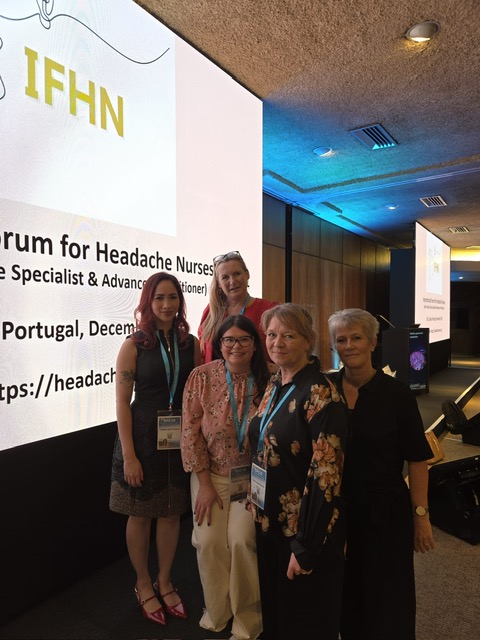
The International Forum of Headache Nurses (IFHN) held an educational symposium at the 19th European Headache Congress (EHC) in Lisbon in December 2025. The Forum session was attended by approximately 100 delegates and was chaired by Headache/Migraine specialist nurse, Esther Tomkins (Beaumont Hospital, Dublin, Ireland). There were three invited headache nurse specialists and their presentations highlighted key areas surrounding migraine stigma.
IFHN Co-founder and outgoing President, Ms. Annette Rasmussen (Headache specialist nurse, University Hospital Zealand, Roskilde, Denmark) opened the session and spoke briefly about the history of IFHN before announcing the transfer of the presidency Ms Jennifer Trouerbach, (Headache specialist nurse, Leiden Headache Centre, Netherlands). Annette will remain on the Board and will continue as an active member of the IFHN.
The first speaker, Ms. Judeia Lyka Pacana (Headache/Migraine specialist nurse, University College London Hospitals, Queen Square, London, UK), discussed the stigma of migraine in the wider community and the common misconceptions of people in general and also healthcare professionals. She pointed out that migraine is still underdiagnosed, misdiagnosed, and undertreated. Her talk also highlighted the fact that migraine is a biological condition with virtually no biomarkers. It is not just a bad headache that only affects women. One key point is that migraine should not be oversimplified as it is a complex neurological disorder with multiple clinical features and a wide array of presentations. Migraine patients are often not straightforward in terms of diagnosis and management. In addition, there is significant burden and disability associated with more chronic migraine including sleep disturbance, anxiety and depression.
Ms. Eulalia Gine Cipres (Headache/Migraine specialist nurse, Vall d’Hebron Hospital and Research Institute, Barcelona, Spain) then addressed the fact that headache specialist nurses are not recognised enough for their role. This was a talk addressing professional stigma and the correlation with patient stigma. She spoke passionately about how many patients with migraine feel misunderstood, judged or invisible when living with migraine. She then focused on how some nurses feel undervalued in their headache roles and can feel ignored or excluded professionally. Migraine may be stigmatised by colleagues as an unimportant medical or neurological condition. Some of the main deficiency areas highlighted were lack of education, lack of specialised training, lack of formal recognition of headache nursing practice and more importantly lack of awareness of the scope of headache nursing practice. This has been demonstrated by the lack of awareness of expanded specialist and advance practice roles within Headache Medicine.
The last speaker was Maren Ostergaard Eriksen, (Headache/Migraine specialist nurse, Hemi Klinikken, Frederiksberg, Denmark) and she addressed the stigma of living with migraine. She discussed the results of the recent European Headache and Migraine Alliance (EHMA) study: “Migraine stigma and general knowledge of migraine: A cross-sectional European Survey” (Goadsby et al, Cephalalgia, 45, 9, 2025). It reported that 53% of patients felt the disease was not well understood, 40% felt that it was not understood at all and 57% felt medical professionals only partially understood. Maren also highlighted ways to combat stigma including both patient and health professional education, public awareness campaigns, more financial resources for Headache Medicine units and patient advocacy.
A interactive and informative question and answer session followed the three presentations, and the session closed noting the next IFHN two-day educational session to be held in person in Oslo, Norway, May 28-29, 2026.
IFHN would like to thank EHF president, Prof. Antoinette Massen van den Brink and the European Headache Federation for inviting us to present at the meeting in Lisbon. It was a very rewarding and valuable experience for all involved.
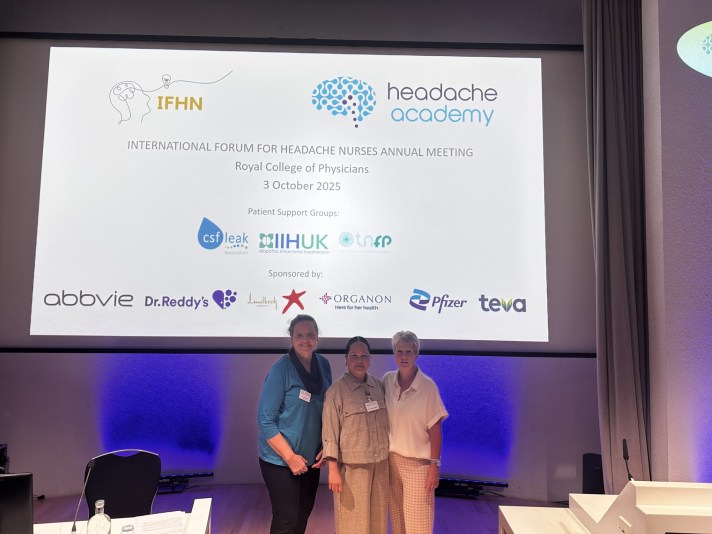
The grand halls of the Royal College of Physicians in London buzzed with anticipation as healthcare professionals from around the world gathered for a truly historic event — the International Headache Nurses Meeting 2025.
For the first time, the International Forum for Headache Nurses (IFHN), in collaboration with the Headache Academy, brought this global meeting to London — a fitting setting for a celebration of learning, collaboration, and professional pride.
Ninety-two delegates filled the venue, representing an impressive array of countries — from Japan and Australia to Spain, the Netherlands, Norway, Ireland, and across the United Kingdom. The audience was as diverse as it was passionate, with headache nurses, pharmacists, physiotherapists, chiropractors, and psychologists all united by one shared mission: to improve the lives of people living with headache and facial pain.
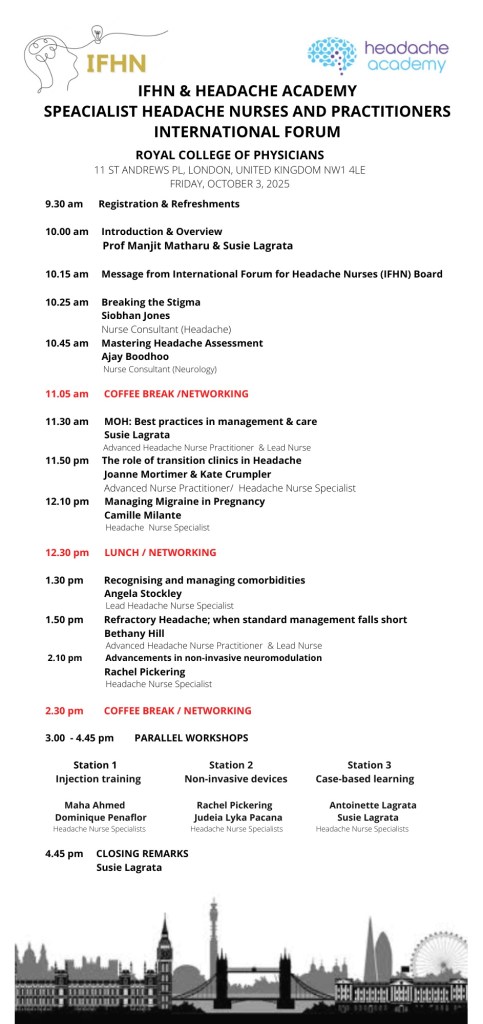
The meeting began with a warm welcome from Professor Manjit Matharu, a world-renowned neurologist and leading figure in headache medicine, alongside Susie Lagrata, IFHN Board Member and Advanced Headache Nurse Practitioner.
Standing before a packed auditorium, Professor Matharu captured the spirit of the day with his heartfelt words: “Today, we celebrate the people who keep headache services moving, the nurses and allied health professionals who form the backbone of care. You are the ones who ensure access, continuity, and outcomes from triage to advanced therapeutics. You innovate through nurse-led clinics, you educate and advocate… empowering patients, upskilling teams, and shaping policy. You measure and improve through audit, research, and service redesign, creating impact at scale. With global reach and local excellence, your contribution is recognised and deeply appreciated worldwide. Your expertise is defining the future of headache care.”
His address set a tone of gratitude and empowerment — a reminder of just how far the field of headache nursing has come and how vital it continues to be. Following the opening remarks and a warm address from IFHN board members Susie, Gøril Bruvik Gravdahl and Jennifer Trouerbach.
The morning sessions began each one a showcase of expertise, empathy, and innovation. Siobhan Jones, Consultant Nurse in Headache, opened the first session with “Breaking the Stigma: Changing Perceptions of Migraine.” Her talk invited the audience to challenge misconceptions surrounding migraine and to reframe it as a serious neurological condition deserving of compassion, attention, and proactive management. Her message resonated deeply: that education and empathy are as crucial as treatment itself.
Next, Ajay Boodhoo, Neurology Nurse Consultant, delivered “Mastering Headache Assessment: A Nursing Perspective.” His session combined clinical wisdom with practical strategies, guiding delegates through the subtleties of assessment — listening, observing, and understanding the patient’s journey beyond symptoms.
Then, Susie Lagrata returned to the podium with a powerful and clinically grounded session on “Medication Overuse Headache (MOH): Best Practices in Management & Care.” Drawing on evidence-based guidelines and her extensive experience, she explored the complex nature of MOH and the importance of combining empathy with structured intervention. Susie explained that effective management rests on three essential pillars: education and counselling, withdrawal of the overused medication, and addressing the underlying primary headache disorder through preventive treatment. She highlighted how these approaches, when delivered through compassionate and multidisciplinary care, lead not only to symptom relief but also to long-term recovery and patient empowerment. Delegates left her session with renewed confidence and practical strategies they could immediately apply in their clinics.
After a lively coffee break and networking session, delegates were treated to a heartwarming and insightful presentation from Jo Mortimer and Kate Crumpler on “Bridging the Gap: The Role of Transition Clinics in Headache Care.” They shared stories of collaboration between paediatric and adult services, highlighting how continuity of care can change lives for young people navigating chronic headache conditions.
Closing the morning programme, Camille Milante explored one of the most delicate topics in headache care “Managing Migraine in Pregnancy.” Her compassionate discussion offered practical guidance on balancing maternal safety, foetal health, and symptom relief during such a sensitive period, leaving attendees with both clinical pearls and a renewed sense of empathy.
After a refreshing lunch and more networking among colleagues and new friends, the afternoon programme dove into advanced and complex clinical topics. Angela Stockley opened with “Beyond Migraine: Recognising and Managing Comorbidities.” Her talk reminded everyone that no patient exists in isolation. Mental health, sleep disorders, and hormonal influences often intertwine with headache presentations. Her emphasis on holistic care was met with nods of agreement throughout the room.
Next came Bethany Hill, who tackled the challenging topic of “Refractory Headaches: When Standard Treatments Fall Short.” With poise and clinical insight, she guided attendees through evidence based and practical management strategies and the emotional dimensions of caring for patients whose pain persists despite best efforts.
Rachel Pickering followed with a fascinating session on “Advancements in Non-Invasive Neuromodulation for Headache Relief.” Demonstrating the latest in device-based therapy, Rachel sparked enthusiasm for how technology continues to evolve in supporting patient-centred care.
The day concluded with vibrant interactive workshops, allowing delegates to turn theory into practice in a dynamic learning environment. At Station 1, Maha Ahmed and Dominique Penaflor led Injection Training for Headache Management, giving participants the opportunity to refine their technique under expert guidance. At Station 2, Lyka Pacana and Rachel Pickering focused on Hands-On Non-Invasive Devices, letting attendees trial and discuss emerging neuromodulation technologies. Meanwhile, at Station 3, Susie Lagrata and Antoinette Lagrata facilitated Case-Based Learning: Real-World Scenarios in Headache Care, where participants explored challenging cases and shared insights from their own practice.
The room was alive with curiosity, conversation, and collaboration the perfect culmination of a day dedicated to education and exchange. Throughout the event, delegates repeatedly expressed how valuable the programme had been rich in learning, practical in focus, and generous in spirit. Many described leaving with new knowledge they could immediately apply in their clinics, and new friendships that would continue beyond the meeting halls.
The success of this historic event would not have been possible without the exceptional generosity of Professor Manjit Matharu, whose support allowed the conference to be offered completely free of charge, including complimentary accommodation for all delegates. His commitment to advancing headache care and empowering the nursing community was evident in every detail of the day.
Special thanks were also extended to Susie Lagrata, lead organiser, event chair and IFHN Board Member, and to the Headache and Facial Pain Service headache nursing team at the National Hospital for Neurology and Neurosurgery, University College London Hospitals NHS Foundation Trust, whose hard work, dedication, and vision brought the event to life.
As the day drew to a close, the air was filled with both pride and possibility. The 2025 IFHN’s International Headache Nurses Meeting was more than a conference, it was a celebration of the profession, a gathering of minds, and a reminder that collaboration across borders can move mountains in patient care.
In the words of one delegate, “It wasn’t just about learning, it was about belonging. We left inspired, connected, and ready to make a difference.”
With hearts full and minds inspired, the community now looks forward to next year’s meeting in Oslo, Norway — a new chapter in the journey of connection, growth, and innovation. If London marked a historic milestone, Oslo promises to carry the torch even higher, uniting professionals once again in the shared pursuit of excellence in headache care.
The International Forum for Headache Nurses’ (IFHN) session at the 18th European Headache Congress in Rotterdam, Netherlands, drawing more than 100 attendees, including nurses, allied health professionals (AHPs), and neurologists from the UK, Sweden, the Netherlands, Norway, Belgium, Spain, Ireland, Canada, and Denmark. Held on Friday morning from 9:00 to 10:30 am, the session showcased the vital role of headache nurses in advancing care and research while fostering meaningful discussions and collegiate connections.
Chaired by Jennifer Trouerbach-Kraan, the session opened with Jennifer welcoming attendees and introducing the IFHN. Reflecting on the forum’s journey across local and international platforms, she set an inspiring tone for the morning, highlighting the forum’s mission to unite headache nursing professionals worldwide.
The session featured three engaging speakers who shared their expertise and insights. First speaker was Louise Schlosser Mose from Denmark, who presented via a recorded video on her published work, Consensus Recommendations on the Role of Nurses in Headache Care: a north and central European e-delphi study. She provided a detailed overview of her study, discussing its methodology and its important findings. While acknowledging the diversity in nursing roles across different countries, Louise emphasised that her research aims to inspire further development of headache nurse’s framework tailored to local healthcare systems.
Maha Ahmed, a headache nurse specialist from the United Kingdom, followed with a presentation on Utilising Quality Improvement in Headache Care and Service Delivery. She emphasised the critical role of quality improvement in healthcare, offering practical tips for launching impactful projects. Through two compelling case studies, Maha demonstrated how quality improvement initiatives can enhance patient outcomes, improve experiences, and establish pioneering nurse-led services. She concluded with her team’s ongoing research comparing nurse-led and consultant-led Botox clinics, which generated significant interest among attendees.
The final speaker, Janneke de Man-van Ginkel from Netherlands, delivered a powerful talk on the Importance of Research in Nursing. She underscored the necessity of continuity of care in healthcare and highlighted how embedding research into nursing practice can drive innovation and ensure seamless patient care. Janneke’s presentation inspired attendees to see themselves as leaders in research within the evolving field of headache nursing.
The session concluded with a lively and interactive discussion, where attendees shared insights, asked thought-provoking questions, and explored how the lessons from the presentations could be applied to their own practices. This exchange of ideas reinforced the importance of networking and collaboration in advancing headache care and highlighted the power of collective efforts in overcoming challenges.
As the session ended, Chair Jennifer encouraged everyone to spread the word about the forum and invite others to join. “There is strength in numbers,” she reminded attendees, emphasising the importance of growing the forum’s community to amplify its impact and reach.
The IFHN session in Rotterdam was more than just an opportunity to share knowledge; it was a celebration of the dedication and expertise of headache nurses and allied health professionals worldwide. Attendees left inspired, connected, and ready to contribute to the ongoing growth of headache nursing. The IFHN extends its gratitude to the speakers, participants, and organisers who made this session a resounding success. Together, we are shaping the future of headache care—one step, one connection, and one innovation at a time.
We are excited to announce a dedicated programme for the International Forum for Headache Nurses at the European Headache Congress in Rotterdam, Netherlands!
Date: December 6, 2024 9 am to 10.30 am session
Location: Rotterdam, Netherlands, European Headache Congress
Our topics includes the following:
• Consensus Recommendations on the Role of Nurses in Headache Care
A key session will feature the presentation of consensus recommendations from a North and Central European e-Delphi study. These recommendations outline the critical role that nurses play in headache care, establishing a framework for our practice and expanding our impact in patient outcomes.
• Enhancing Headache Daycare Through Audit and Quality Improvement Strategies
Discussion on methods for improving headache daycare through targeted audit and quality improvement initiatives in our headache clinics. This session will focus on practical tools and strategies to enhance the quality of care for headache patients.
• Continuity of Care in Changing Times: Research in Nursing Practice
Explore recent research on continuity of care within the evolving field of headache nursing. This session will cover innovative approaches to maintaining seamless patient care as healthcare environments and nursing practices adapt to meet new challenges. This event is a valuable opportunity for all headache nurses to connect, learn, and contribute to the growth of our field. It is also a great platform to network, reconnect, and catch up with colleagues. We are excited to see everyone in Rotterdam and look forward to inspiring gathering and strengthening our community.
International Forum of Headache Nurses (IFHN) & Spanish Society for Neurology Nursing (SEDENE)
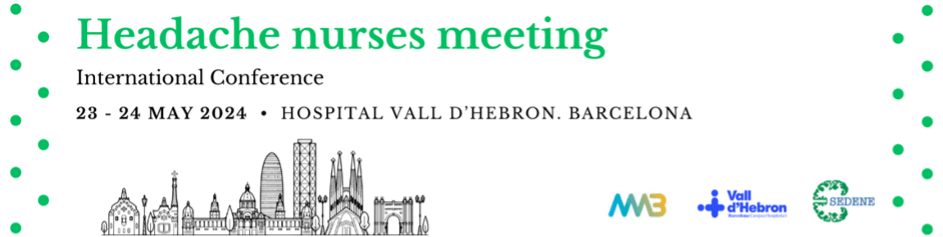
Headache Nurse Congress, Barcelona, May 23rd & 24th 2024
On May 23rd and 24th 2024, the International Forum of Headache Nurses (IFHN), in conjunction with the Spanish Society for Neurology Nursing (SEDENE), held their annual educational congress at the University Hospital Vall d’Hebron, Barcelona, Spain. This meeting was very successful with more than 40 Headache/Migraine nurses attending from seven different countries, with one of our colleagues travelling from Osaka, Japan.
The two-day meeting began with a tour of the clinical areas of the Headache Unit at Hospital Vall d’Hebron, led by Dr Patricia Pozo-Rosich, Consultant Neurologist and Director of the unit. This was followed by welcome remarks from Lali Gine (Headache Nurse host & coordinator of the meeting), who then introduced the five speakers for day one. The first four speakers were from the Headache Unit at Hospital Vall d’Hebron and the Vall d’Hebron Institute of Research. Their various presentations outlined key areas of nursing care and different aspects of Headache Medicine at their centre.
The first speaker was Ms Marta Vila and she spoke about preclinical models in rodents. It is postulated that such work can help us understand more about the pathophysiology of migraine in humans. Projects at their laboratory are focussing on genetics, neuroimaging and electrophysiological studies.
Dr Pozo-Rosich then gave a more general talk about Headache burden globally and management strategies for patients in Spain. She highlighted the significant disability, economic loss and disruption to daily life as a result of migraine. She spoke of the importance of education of various healthcare professionals or HCP (including Neurologists, other Physicians and Nurses) and patients, with the primary goal being improvement of the quality of life of patients suffering from headache disorders. As is the case in many specialist centres internationally, there is a multidisciplinary approach to Headache Medicine in Spain. Dr Pozo-Rosich paid tribute to her headache nursing team (and in particular Ms Lali Gine) and emphasised the significant value and important role that specialist headache nurses have in patient care.
Dr Edoardo Caronna (Consultant Neurologist) gave a more research focussed presentation titled “Innovation and Research”. He outlined the importance of basic laboratory research and real-world clinical evidence-based research in the ever-evolving world of Headache Medicine. He presented a summary of the more recent data on CGRP pathway inhibitors and cited several papers which help guide clinical practice at many of our centres internationally.
Ms Lali Gine then gave a clinical presentation describing the role of the Headache Nurse in Spain and how this role is growing and evolving. She spoke specifically about the work of SEDENE, who are trying to improve education and training for Headache Nurses nationally. It was very positive to hear how many neurologists across Spain are supporting this nursing initiative. A multidisciplinary approach to clinical care was also highlighted in her presentation and she specifically outlined how permanent experienced specialist nurses can lead patient care together with all other relevant HCP.
Ms Annette Rasmussen (Headache Specialist Nurse, Denmark) then delivered the International Forum of Headache Nurses (IFHN) Annual Report. The IFHN now has over 200 members from around the world and this number is growing annually. She spoke about the invaluable specialist skills that Headache Nurses bring to patient care. It is noteworthy that the European Headache Federation (EHF) has now invited the IFHN to present a nursing information session at their Meeting in Rotterdam in December 2024.
At the end of the presentations on day one, Ms Lali Gine invited the entire group to dinner that night and this was enjoyed by all who attended. It gave an excellent opportunity for socialising and networking informally.
On day two, the first presentation was by Dr Adela Zabalegui (Advanced Nurse Practitioner Tutor and National Representative). She spoke about the clinical role of Nurse Specialists and Advanced Nurse Practitioners in Spain. She described the advances that have been made in nursing, and the impact that specialist nurses and those working in advanced practice can have on patient care. Dr Zabalegui also highlighted the need for more national resources and support so that Headache Nurse Specialists and Advanced Nurse Practitioners continue to be recognised and encouraged.
Ms Jennifer Trouerbach (Headache Specialist Nurse, Netherlands) and Ms Annette Rasmussen led the next session exploring what the ideal headache nurse model should be in terms of staffing and the nursing roles. A round table small group session followed thereafter. Representatives from each group spoke about what they felt were the most important roles of the headache nurse with education, knowledge, active listening and empathy being some of the areas highlighted.
Finally, Ms Trouerbach, Ms Rasmussen, Ms Gine and Ms Gravdahl (Headache Specialist Nurse, Norway) presented some interesting and challenging clinical cases and case reports. The participants discussed the case reports in small mixed groups and interesting discussions followed on stage with one representative from each group in plenary setting.
The meeting closed at lunchtime and special thanks was given to Ms Lali Gine, Dr Pozo-Rosich and all the Headache Team at Hospital Vall d’Hebron, for their work in organizing a very educational and rewarding meeting that was enjoyed by all who attended. A special word of thanks was given to the Board of the International Forum of Headache Nurses (IFHN): Jennifer Trouerbach, Annette Rasmussen, Gøril Bruvik Gravdahl, Esther Tomkins (Headache Specialist Nurse, Ireland) and Susie Lagrata (Advanced Headache Nurse Practitioner, UK) for their support in coordinating the meeting.
We are very pleased to announce our next international meeting in IFHN in collaboration with the Spanish headache nurses in Barcelona in May 2024.
The meeting starts at 11.00 May 23rd, and finishes at 15.00 May 24th.
Address of the hospital: Vall d’Hebron Hospital. Pg. de la Vall d’Hebron, 119, 08035. Barcelona
Suggestion for a hotel 5 minutes’ walk to the hospital: Hotel Alimara Carrer de Berruguete, 126, 08035. Barcelona.
We would appreciate your confirmation of attendance as soon possible and latest at March 1st 2024.
You will meet headache nurses from many countries and we will empower each other with knowledge!
If you want to join, please register as a member on this web-site. All our member will receive a personal invitation with contact details.
Preliminary program
Day 1 -23/05/2023
11:00 – 11:30 – Café
11:30 – 11:45 – Welcome and introduction
11:45 – 12:45 – Migraine, a public brain disease – Dr. Patricia Pozo Rosich
Migraine is a highly prevalent, underdiagnosed, undertreated, and stigmatized disease. In this talk, Dr. Pozo will talk to us about the ideal model to treat not only our patients but also migraine as a concept and as a general problem of society. In addition to offering certain keys to treating migraine from the innovative model of precision medicine.
12:45 – 13:30 – Preclinical models – Neuroscientist Marta Vila Pueyo
Preclinical models are a crucial tool to improve the understanding of human pathologies. In the field of headache, there are several validated preclinical models in rodents that are routinely being used to understand different aspects of the disease and to uncover new therapeutic targets. In the animal adaptive brain laboratory, we are currently using a nitroglycerin-induced chronic migraine model to assess the impact of several stressful situations in the development of orofacial allodynia and CGRP expression.
13:30 – 14:30 – Lunch
14:30 – 15:00- Innovation and research in migraine – Dr. Edoardo Caronna
For some years now, there has been a lot of research into headaches and migraines. Dr. Caronna will talk about new diagnostic and therapeutic techniques for migraine and what are the moonshots for the coming years.
15:00 – 15:30 – Evolution of headache nurses in Spain and SEDENE – Nurse Lali Giné
For relatively few years now, headache nurses have been developing their care activities in headache units. We will talk about the evolution of these nurses, the different models of nurses that exist in Spain and the scientific society that supports these new roles.
15:30 – 16:00 – Annual report IFHN – President of IFHN Annette Vangaa Rasmussen
16:00 – 16:30 – Coffee
16:30 – 17:30 – Visit to the Headache Unit
On this visit, we will be able to see the facilities of the migraine adaptive brain center, of the Vall d’Hebron Hospital. It combines healthcare activities with research in patients suffering from headaches.
Barcelona tour and dinner
Day 2 – 24/05/2023
08:30 – 09:00- Good morning café
09:00 – 10:00 – APRN in Spain and nursing now program – PhD/nurse Adela Zabalegui
The APRN (Advanced Practice Registered Nurse) is at different levels depending on the country. Adela Zabalegui will explain how the APRN model is developing in Spain, what legal situation it is in and what the future steps are for the consolidation of the APRN. She will also talk to us about the importance of clinical research in nursing and different European supports for research.
10:00 – 11:00 – Discussion of the attendees on what the ideal headache nurse model is and should be like – Jennifer Trouerbach/Annette Vangaa Rasmussen/Teresa Marco/Lali Giné /Gøril Bruvik Gravdahl
In this workshop, we will separate the attendees by country at different tables. First, we are going to discuss the tasks in separate tables, and a representative of each table will explain the tasks carried out by headache nurses. Then the ideals of headache nurses in each country will be explained. The objective of this workshop is to have a general idea of what the colleagues do and try to contribute new ideas to incorporate them into different healthcare practices.
11:00 -11:30 – Coffee
11:30 – 12:30 – Workshop on clinical cases/case reports – Jennifer Trouerbach/
Topics: medication overuse headache, chronic migraine and refractory cases.
In this workshop, we will propose different clinical cases, one different per table. Following that, each table will present their clinical case and how they would approach it. Together we will debate different visions to offer the best care to the patients of the cases.
12:30 – 13:00 – Closing and farewell – Jennifer/Annette/Teresa/Lali


 IFHN
IFHN 