19th European Headache Congress (EHC), Lisbon, Portugal.
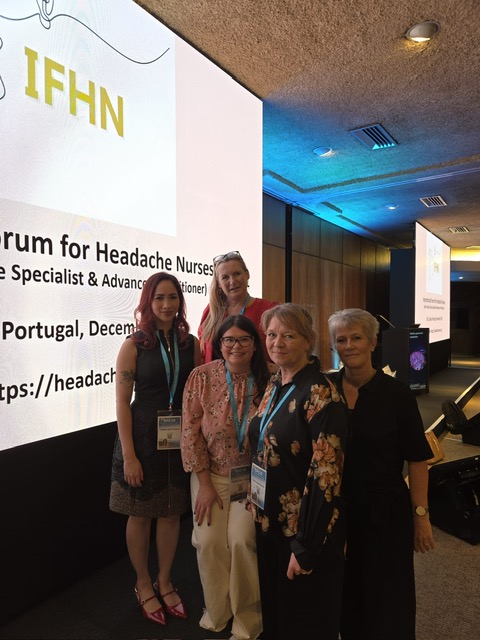
The International Forum of Headache Nurses (IFHN) held an educational symposium at the 19th European Headache Congress (EHC) in Lisbon in December 2025. The Forum session was attended by approximately 100 delegates and was chaired by Headache/Migraine specialist nurse, Esther Tomkins (Beaumont Hospital, Dublin, Ireland). There were three invited headache nurse specialists and their presentations highlighted key areas surrounding migraine stigma.
IFHN Co-founder and outgoing President, Ms. Annette Rasmussen (Headache specialist nurse, University Hospital Zealand, Roskilde, Denmark) opened the session and spoke briefly about the history of IFHN before announcing the transfer of the presidency Ms Jennifer Trouerbach, (Headache specialist nurse, Leiden Headache Centre, Netherlands). Annette will remain on the Board and will continue as an active member of the IFHN.
The first speaker, Ms. Judeia Lyka Pacana (Headache/Migraine specialist nurse, University College London Hospitals, Queen Square, London, UK), discussed the stigma of migraine in the wider community and the common misconceptions of people in general and also healthcare professionals. She pointed out that migraine is still underdiagnosed, misdiagnosed, and undertreated. Her talk also highlighted the fact that migraine is a biological condition with virtually no biomarkers. It is not just a bad headache that only affects women. One key point is that migraine should not be oversimplified as it is a complex neurological disorder with multiple clinical features and a wide array of presentations. Migraine patients are often not straightforward in terms of diagnosis and management. In addition, there is significant burden and disability associated with more chronic migraine including sleep disturbance, anxiety and depression.
Ms. Eulalia Gine Cipres (Headache/Migraine specialist nurse, Vall d’Hebron Hospital and Research Institute, Barcelona, Spain) then addressed the fact that headache specialist nurses are not recognised enough for their role. This was a talk addressing professional stigma and the correlation with patient stigma. She spoke passionately about how many patients with migraine feel misunderstood, judged or invisible when living with migraine. She then focused on how some nurses feel undervalued in their headache roles and can feel ignored or excluded professionally. Migraine may be stigmatised by colleagues as an unimportant medical or neurological condition. Some of the main deficiency areas highlighted were lack of education, lack of specialised training, lack of formal recognition of headache nursing practice and more importantly lack of awareness of the scope of headache nursing practice. This has been demonstrated by the lack of awareness of expanded specialist and advance practice roles within Headache Medicine.
The last speaker was Maren Ostergaard Eriksen, (Headache/Migraine specialist nurse, Hemi Klinikken, Frederiksberg, Denmark) and she addressed the stigma of living with migraine. She discussed the results of the recent European Headache and Migraine Alliance (EHMA) study: “Migraine stigma and general knowledge of migraine: A cross-sectional European Survey” (Goadsby et al, Cephalalgia, 45, 9, 2025). It reported that 53% of patients felt the disease was not well understood, 40% felt that it was not understood at all and 57% felt medical professionals only partially understood. Maren also highlighted ways to combat stigma including both patient and health professional education, public awareness campaigns, more financial resources for Headache Medicine units and patient advocacy.
A interactive and informative question and answer session followed the three presentations, and the session closed noting the next IFHN two-day educational session to be held in person in Oslo, Norway, May 28-29, 2026.
IFHN would like to thank EHF president, Prof. Antoinette Massen van den Brink and the European Headache Federation for inviting us to present at the meeting in Lisbon. It was a very rewarding and valuable experience for all involved.
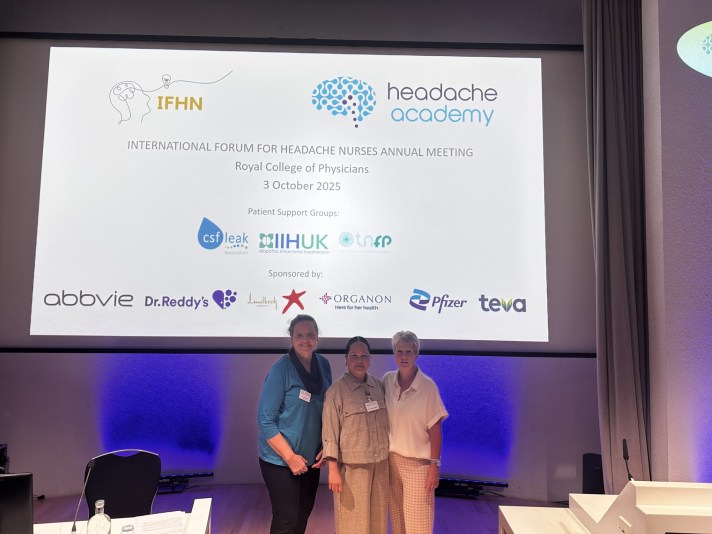
The grand halls of the Royal College of Physicians in London buzzed with anticipation as healthcare professionals from around the world gathered for a truly historic event — the International Headache Nurses Meeting 2025.
For the first time, the International Forum for Headache Nurses (IFHN), in collaboration with the Headache Academy, brought this global meeting to London — a fitting setting for a celebration of learning, collaboration, and professional pride.
Ninety-two delegates filled the venue, representing an impressive array of countries — from Japan and Australia to Spain, the Netherlands, Norway, Ireland, and across the United Kingdom. The audience was as diverse as it was passionate, with headache nurses, pharmacists, physiotherapists, chiropractors, and psychologists all united by one shared mission: to improve the lives of people living with headache and facial pain.
The meeting began with a warm welcome from Professor Manjit Matharu, a world-renowned neurologist and leading figure in headache medicine, alongside Susie Lagrata, IFHN Board Member and Advanced Headache Nurse Practitioner.
Standing before a packed auditorium, Professor Matharu captured the spirit of the day with his heartfelt words: “Today, we celebrate the people who keep headache services moving, the nurses and allied health professionals who form the backbone of care. You are the ones who ensure access, continuity, and outcomes from triage to advanced therapeutics. You innovate through nurse-led clinics, you educate and advocate… empowering patients, upskilling teams, and shaping policy. You measure and improve through audit, research, and service redesign, creating impact at scale. With global reach and local excellence, your contribution is recognised and deeply appreciated worldwide. Your expertise is defining the future of headache care.”
His address set a tone of gratitude and empowerment — a reminder of just how far the field of headache nursing has come and how vital it continues to be. Following the opening remarks and a warm address from IFHN board members Susie, Gøril Bruvik Gravdahl and Jennifer Trouerbach.
The morning sessions began each one a showcase of expertise, empathy, and innovation. Siobhan Jones, Consultant Nurse in Headache, opened the first session with “Breaking the Stigma: Changing Perceptions of Migraine.” Her talk invited the audience to challenge misconceptions surrounding migraine and to reframe it as a serious neurological condition deserving of compassion, attention, and proactive management. Her message resonated deeply: that education and empathy are as crucial as treatment itself.
Next, Ajay Boodhoo, Neurology Nurse Consultant, delivered “Mastering Headache Assessment: A Nursing Perspective.” His session combined clinical wisdom with practical strategies, guiding delegates through the subtleties of assessment — listening, observing, and understanding the patient’s journey beyond symptoms.
Then, Susie Lagrata returned to the podium with a powerful and clinically grounded session on “Medication Overuse Headache (MOH): Best Practices in Management & Care.” Drawing on evidence-based guidelines and her extensive experience, she explored the complex nature of MOH and the importance of combining empathy with structured intervention. Susie explained that effective management rests on three essential pillars: education and counselling, withdrawal of the overused medication, and addressing the underlying primary headache disorder through preventive treatment. She highlighted how these approaches, when delivered through compassionate and multidisciplinary care, lead not only to symptom relief but also to long-term recovery and patient empowerment. Delegates left her session with renewed confidence and practical strategies they could immediately apply in their clinics.
After a lively coffee break and networking session, delegates were treated to a heartwarming and insightful presentation from Jo Mortimer and Kate Crumpler on “Bridging the Gap: The Role of Transition Clinics in Headache Care.” They shared stories of collaboration between paediatric and adult services, highlighting how continuity of care can change lives for young people navigating chronic headache conditions.
Closing the morning programme, Camille Milante explored one of the most delicate topics in headache care “Managing Migraine in Pregnancy.” Her compassionate discussion offered practical guidance on balancing maternal safety, foetal health, and symptom relief during such a sensitive period, leaving attendees with both clinical pearls and a renewed sense of empathy.
After a refreshing lunch and more networking among colleagues and new friends, the afternoon programme dove into advanced and complex clinical topics. Angela Stockley opened with “Beyond Migraine: Recognising and Managing Comorbidities.” Her talk reminded everyone that no patient exists in isolation. Mental health, sleep disorders, and hormonal influences often intertwine with headache presentations. Her emphasis on holistic care was met with nods of agreement throughout the room.
Next came Bethany Hill, who tackled the challenging topic of “Refractory Headaches: When Standard Treatments Fall Short.” With poise and clinical insight, she guided attendees through evidence based and practical management strategies and the emotional dimensions of caring for patients whose pain persists despite best efforts.
Rachel Pickering followed with a fascinating session on “Advancements in Non-Invasive Neuromodulation for Headache Relief.” Demonstrating the latest in device-based therapy, Rachel sparked enthusiasm for how technology continues to evolve in supporting patient-centred care.
The day concluded with vibrant interactive workshops, allowing delegates to turn theory into practice in a dynamic learning environment. At Station 1, Maha Ahmed and Dominique Penaflor led Injection Training for Headache Management, giving participants the opportunity to refine their technique under expert guidance. At Station 2, Lyka Pacana and Rachel Pickering focused on Hands-On Non-Invasive Devices, letting attendees trial and discuss emerging neuromodulation technologies. Meanwhile, at Station 3, Susie Lagrata and Antoinette Lagrata facilitated Case-Based Learning: Real-World Scenarios in Headache Care, where participants explored challenging cases and shared insights from their own practice.
The room was alive with curiosity, conversation, and collaboration the perfect culmination of a day dedicated to education and exchange. Throughout the event, delegates repeatedly expressed how valuable the programme had been rich in learning, practical in focus, and generous in spirit. Many described leaving with new knowledge they could immediately apply in their clinics, and new friendships that would continue beyond the meeting halls.
The success of this historic event would not have been possible without the exceptional generosity of Professor Manjit Matharu, whose support allowed the conference to be offered completely free of charge, including complimentary accommodation for all delegates. His commitment to advancing headache care and empowering the nursing community was evident in every detail of the day.
Special thanks were also extended to Susie Lagrata, lead organiser, event chair and IFHN Board Member, and to the Headache and Facial Pain Service headache nursing team at the National Hospital for Neurology and Neurosurgery, University College London Hospitals NHS Foundation Trust, whose hard work, dedication, and vision brought the event to life.
As the day drew to a close, the air was filled with both pride and possibility. The 2025 IFHN’s International Headache Nurses Meeting was more than a conference, it was a celebration of the profession, a gathering of minds, and a reminder that collaboration across borders can move mountains in patient care.
In the words of one delegate, “It wasn’t just about learning, it was about belonging. We left inspired, connected, and ready to make a difference.”
With hearts full and minds inspired, the community now looks forward to next year’s meeting in Oslo, Norway — a new chapter in the journey of connection, growth, and innovation. If London marked a historic milestone, Oslo promises to carry the torch even higher, uniting professionals once again in the shared pursuit of excellence in headache care.
We are excited to announce a dedicated programme for the International Forum for Headache Nurses at the European Headache Congress in Rotterdam, Netherlands!
Date: December 6, 2024 9 am to 10.30 am session
Location: Rotterdam, Netherlands, European Headache Congress
Our topics includes the following:
• Consensus Recommendations on the Role of Nurses in Headache Care
A key session will feature the presentation of consensus recommendations from a North and Central European e-Delphi study. These recommendations outline the critical role that nurses play in headache care, establishing a framework for our practice and expanding our impact in patient outcomes.
• Enhancing Headache Daycare Through Audit and Quality Improvement Strategies
Discussion on methods for improving headache daycare through targeted audit and quality improvement initiatives in our headache clinics. This session will focus on practical tools and strategies to enhance the quality of care for headache patients.
• Continuity of Care in Changing Times: Research in Nursing Practice
Explore recent research on continuity of care within the evolving field of headache nursing. This session will cover innovative approaches to maintaining seamless patient care as healthcare environments and nursing practices adapt to meet new challenges. This event is a valuable opportunity for all headache nurses to connect, learn, and contribute to the growth of our field. It is also a great platform to network, reconnect, and catch up with colleagues. We are excited to see everyone in Rotterdam and look forward to inspiring gathering and strengthening our community.

 IFHN
IFHN 